
DENGUE PATROL
ACTIVITIES
DAY 14: 1 OCTOBER 2015 (THURSDAY)
|
DATE
|
DAY
|
ACTIVITIES
|
|
DAY 14
1
/10/2015
THURSDAY
|
Team activity in dengue patrol
operation room
Display dengue poster
around the school compound.
|
|
|
Update Dengue
Patrol media social
|
||
Mosquito Life Cycle

The Theory
The mosquitoes are a family of small, midge-like flies. Like all flies, mosquitoes go through four stages in their life - egg, larva, pupa, and adult. We call this as the life cycle. Each of these stages is morphologically different from the other, with even the habitat of each stage differing. The first three stages - egg, larva and pupa are largely aquatic, whereas the adult stage is aerial.Mosquito Life cycle
We will now look at the four distinct stages of development in the life cycle of a mosquito.
Stage 1 - Egg
 The
eggs are laid one at a time and they float on the surface of the water.
Normally the eggs are white when first deposited, then darken to near
black within a day. They hatch in one to three days depending on the
temperature. Eggs left on moist soil can last for up to a year, until
the ground is flooded again, before hatching.
The
eggs are laid one at a time and they float on the surface of the water.
Normally the eggs are white when first deposited, then darken to near
black within a day. They hatch in one to three days depending on the
temperature. Eggs left on moist soil can last for up to a year, until
the ground is flooded again, before hatching.Stage 2 - Larva
 Mosquito
larvae, commonly called ‘wigglers’ or ‘wrigglers’, live in water from 7
to 14 days depending on the water temperature. Larvae swim either
through propulsion with their mouth brushes, or by jerky movements of
their entire bodies, giving them the common name of ‘wigglers’. The
larva begins to feed on bacteria and decaying organic matter on the
water surface, soon after they hatch out of eggs. They spend most of
their time hanging upside down at the surface, sucking in oxygen through
the siphon. The siphon is located at the base of their abdomen and is
similar to a snorkel. Brushes that are located in front of their mouths
collect the food. Anopheles larvae do not have a siphon and they lay
parallel to the water surface. The larval stage lasts for a few days to a
few weeks, during which the larvae shed several layers of their outer
skin, called moulting. This allows further growth.
Mosquito
larvae, commonly called ‘wigglers’ or ‘wrigglers’, live in water from 7
to 14 days depending on the water temperature. Larvae swim either
through propulsion with their mouth brushes, or by jerky movements of
their entire bodies, giving them the common name of ‘wigglers’. The
larva begins to feed on bacteria and decaying organic matter on the
water surface, soon after they hatch out of eggs. They spend most of
their time hanging upside down at the surface, sucking in oxygen through
the siphon. The siphon is located at the base of their abdomen and is
similar to a snorkel. Brushes that are located in front of their mouths
collect the food. Anopheles larvae do not have a siphon and they lay
parallel to the water surface. The larval stage lasts for a few days to a
few weeks, during which the larvae shed several layers of their outer
skin, called moulting. This allows further growth.Stage 3 - Pupa
 After
the larvae have completed moulting, they become pupae. This is the
stage in which they undergo metamorphosis to become an adult mosquito.
The pupal stage is a resting, non-feeding stage. Mosquito pupae are
commonly called ‘tumblers’. The pupa is lighter than water and therefore
floats at the surface. The mosquito pupa is comma-shaped. The head and
thorax are merged into a cephalothorax, with the abdomen curving around
underneath. At one end of these curved bodies is the large head and at
the other end is the flippers used for swimming. They must take in
oxygen from time to time through two breathing tubes known as
‘trumpets’. After a few days or longer, depending on the temperature and
other circumstances, the pupa rises to the water surface, the dorsal
surface of its cephalothorax splits, and the adult mosquito emerges.
After
the larvae have completed moulting, they become pupae. This is the
stage in which they undergo metamorphosis to become an adult mosquito.
The pupal stage is a resting, non-feeding stage. Mosquito pupae are
commonly called ‘tumblers’. The pupa is lighter than water and therefore
floats at the surface. The mosquito pupa is comma-shaped. The head and
thorax are merged into a cephalothorax, with the abdomen curving around
underneath. At one end of these curved bodies is the large head and at
the other end is the flippers used for swimming. They must take in
oxygen from time to time through two breathing tubes known as
‘trumpets’. After a few days or longer, depending on the temperature and
other circumstances, the pupa rises to the water surface, the dorsal
surface of its cephalothorax splits, and the adult mosquito emerges.Stage 4 - Adult
 The
newly emerged adult rests on the surface of the water for a short time
to allow itself to dry and harden its parts. Also, the wings have to
spread out and dry properly before it can fly.
The
newly emerged adult rests on the surface of the water for a short time
to allow itself to dry and harden its parts. Also, the wings have to
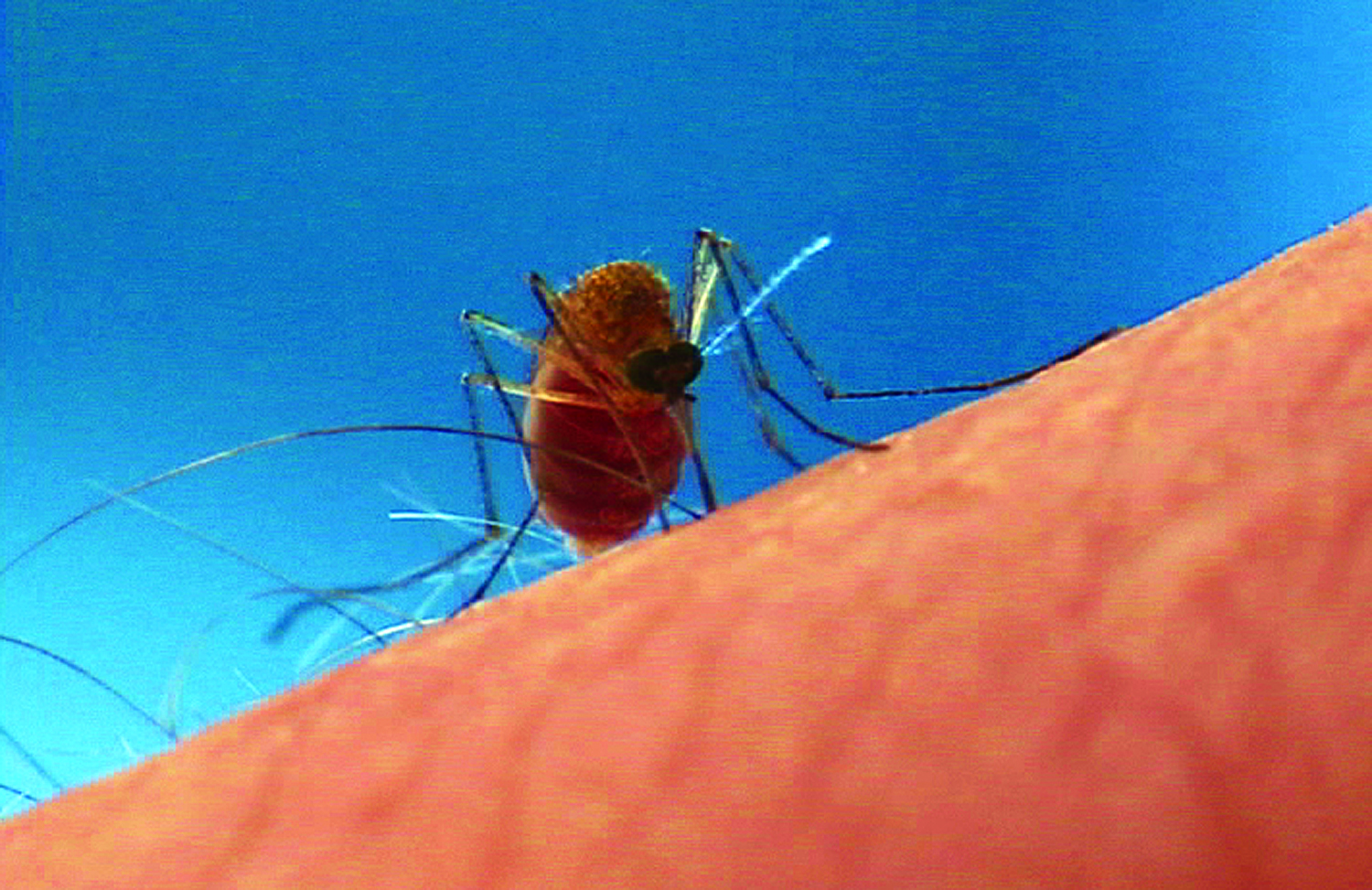
spread out and dry properly before it can fly.Adult mosquitoes have a head with two large compound eyes, a thorax, a pair of scaled wings and six jointed legs. They also have antennae and a proboscis. Adult mosquitoes mate within the first few days after emerging from the pupal stage.
It is the carbon dioxide that we exhale, and the lactic acid from our sweat that combine to make us smell like a mosquito buffet. Mosquitoes can pick up these smells from 100 feet, and they can also feel our body heat and notice movements.
Only female mosquitoes have the mouth parts necessary for sucking blood. When biting with their proboscis, they stab two tubes into the skin, one is an anti-coagulant to keep the blood flowing and is a mild painkiller that helps them escape detection, the other helps to suck blood. They use the blood not for their own nourishment but as a source of protein for their eggs. For food, both males and females eat nectar and other plant sugars.
Some interesting mosquito facts
- There are over 2500 different species of mosquitoes.
- The feeding habits of mosquitoes are quite unique in that it is only the adult females that feed on blood. The male mosquitoes feed only on plant juices.
- Mosquitoes must have water in which to complete their life cycle.
- Most female mosquitoes need to feed on animal blood before they can develop eggs.
- A female can produce up to 500 eggs before she finally dies.
- Mosquitoes don't travel more than a mile from the place where they were hatched.
- The length of life of the adult mosquito usually depends on factors like - temperature, humidity, sex of the mosquito and time of the year.
- Once mosquitoes emerge from their pupal cocoons and take flight, male mosquitoes last less than a week and the females’ maybe a couple of months.
Learning Outcomes
- Students understand the different stages of a Mosquito life cycle.
- Students get to know different types of Mosquitoes and the diseases spread by them.
- Students understand the differences in each stage of the mosquito life cycle through the animated demonstrations.

The length of the
mosquito life cycle varies between species and is dependent upon environmental
conditions such as temperature and moisture. However, the life cycle of all
mosquitoes is comprised of the egg, larval, pupal and adult stages.
Male mosquitoes
feed on plant nectar alone, while females extract the blood of hosts in order
to develop and nourish eggs. Most mosquitoes lay their eggs directly into
water. Others lay their eggs near bodies of water but not within them.
Eggs will hatch
into larvae within 24 to 48 hours. Larvae soon grow to become approximately 5
mm in length. Most larvae breathe through air tubes. Larger larvae can be seen
floating just above the surface of infested waters.
Within seven to 10
days, larvae enter the pupal stage. Pupae are also visible upon the surface of
the breeding site. After a mosquito is fully developed, it will emerge as an
adult from its pupal case. At this time, the new adult stands upon the water
and dries its wings to prepare for flight. Adult female mosquitoes will then
seek an animal on which to feed. Females are capable of flying for miles
if necessary and can lay over 100 eggs at a time.
Larvae and pupae
usually cannot survive without water. If a water source evaporates before
the larvae and pupae within it transform into adult mosquitoes, those young
often will die.
TEAM
ACTIVITIES IN DENGUE PATROL OPERATION ROOM


No comments:
Post a Comment